
Across South Africa, concern about children’s literacy levels has become increasingly urgent. Conversations often focus on what schools are failing to do, what children cannot yet read, or what interventions are needed to “fix” literacy outcomes. These are important concerns. But they can also narrow the way we think about literacy itself.
When literacy is viewed only through the lens of formal schooling, it is easy to overlook the many spaces outside the classroom where children encounter language, stories, identity, imagination, and meaning. Homes, reading clubs, churches, after-school programmes, libraries, playgrounds, and community organisations all shape children’s relationships with reading long before, and long after, formal lessons begin.
Perhaps one of the most important questions we can ask is not simply how to improve literacy instruction, but whose knowledge, language, and experiences are shaping the literacy opportunities children receive.
Too often, literacy initiatives are designed far from the communities they serve. Books are selected externally. Stories are written from outside perspectives. Definitions of what counts as “good literacy” are imposed downward through institutions and programmes. Even well-meaning interventions can unintentionally communicate that expertise belongs with publishers, NGOs, academics, or donors rather than with the communities themselves.
But literacy does not emerge in a vacuum. It is deeply social and cultural. Children learn language through relationships. They learn stories through the voices around them. They learn what matters through what is reflected back to them in books and conversations.
This raises uncomfortable but necessary questions for organisations working in literacy development. Who decides which stories are worth telling? Who gets represented in children’s books? Whose language practices are validated? And how often are communities invited to shape programmes beyond simply implementing them?
These are questions we have increasingly been asking ourselves through Masifunde Sidlala, a literacy initiative launched by Little Zebra Books in 2023.
What began as a book distribution and literacy support project gradually became something more collaborative and more challenging. Through regular engagement with programme partners running reading clubs and after-school programmes, we began hearing detailed feedback about how books were actually being used in community spaces. Practitioners told us that children often wanted stories that were longer, richer, and more engaging. They shared what held children’s attention and what did not. They explained the realities of reading in crowded community spaces with mixed-age groups and varying literacy levels.
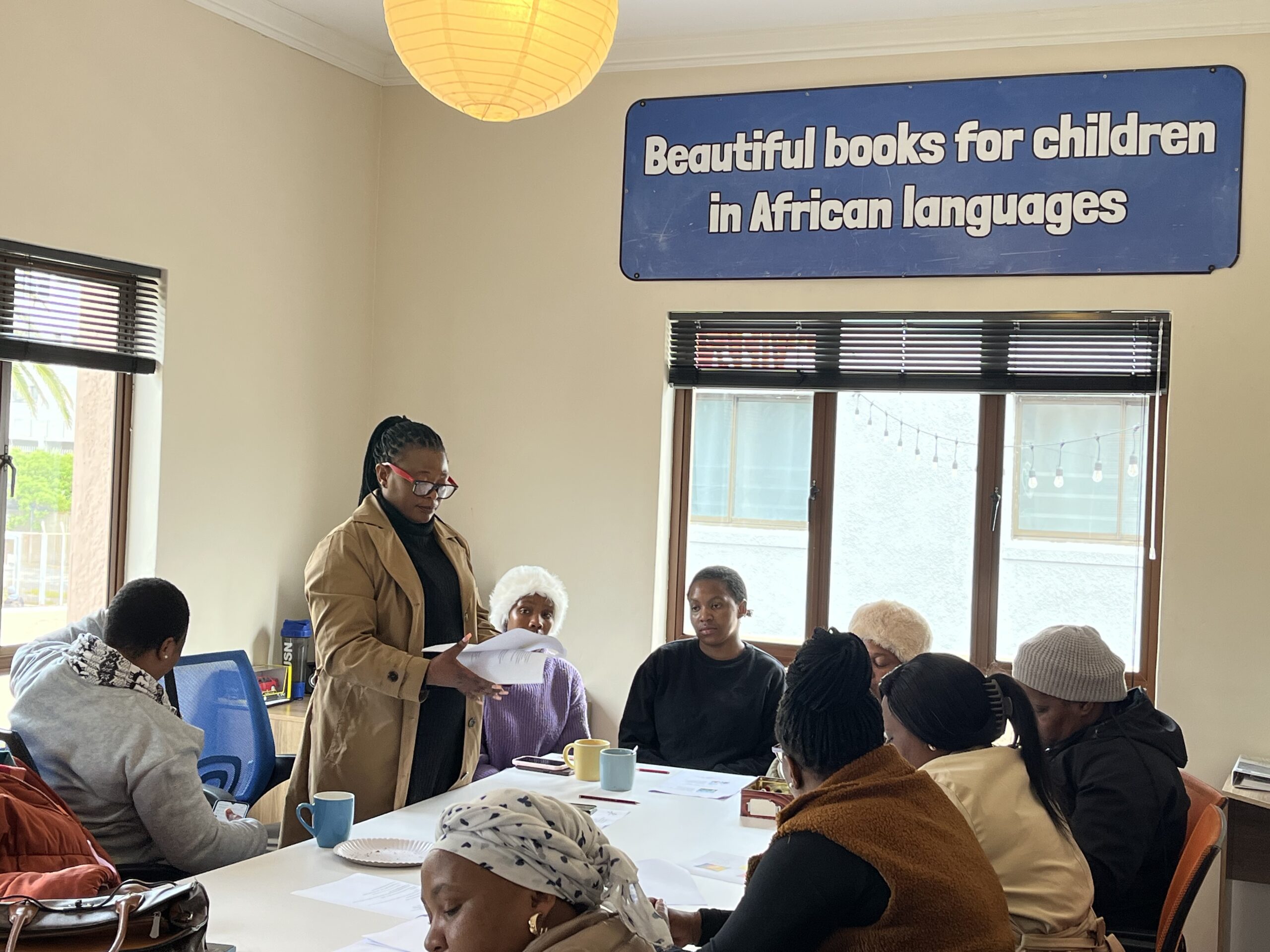
Image: Community practitioners with Masifunde Sidlala meet monthly for planning, learning, and mutual encouragement
None of this information could have been gathered from a distance.
One of the most valuable aspects of the programme is a monthly Community of Practice where facilitators, practitioners, and staff reflect together on what is working and what is not. Rather than treating local partners merely as distributors of resources, the process increasingly positions them as contributors to the design of reading materials themselves.
This eventually led to the development of “StoryShops”: collaborative workshops where community practitioners generate ideas for new children’s stories rooted in their own contexts, humour, language, and experiences. The stories that emerge are lively, playful, culturally grounded, and deeply connected to children’s lives.
Importantly, this process also forced us to confront questions about representation in publishing itself. South African children’s publishing, particularly illustration, still reflects deep structural inequalities shaped by apartheid-era exclusion. Many children continue to encounter books where the visual world feels distant from their own communities and identities.

Image: Vibrant artwork for a story developed through the StoryShop project
Working with artists from backgrounds more reflective of the communities where the books are used has become an important part of the process. It is not simply about visual diversity for its own sake, but about authenticity, perspective, and cultural texture. Stories carry meaning not only through words, but through imagery, gesture, environment, and visual memory.
At the same time, community-driven literacy work is not without its complexities.
There is always a danger that participation becomes symbolic rather than substantive; that organisations invite “community voices” while still retaining most decision-making power. There are difficult questions about sustainability, authorship, quality control, language politics, and whose voices within communities are actually heard. Communities themselves are not uniform; they contain inequalities, exclusions, and competing perspectives.
And yet, despite these challenges, community involvement remains essential because literacy is ultimately relational. Children are more likely to engage deeply with reading when stories feel connected to their worlds, languages, families, humour, fears, and aspirations. Literacy becomes more meaningful when it is not experienced as something imported from outside, but is rooted in everyday life.
If South Africa is serious about building a culture of reading, we may need to broaden our understanding of where literacy development happens and who gets to shape it. Schools remain vital, but they cannot carry this responsibility alone. Community practitioners, caregivers, local storytellers, artists, librarians, and reading club facilitators are not peripheral to literacy development, they are central to it.
Building literacy from the ground up requires more than delivering books to communities. It requires listening to communities, learning from them, and allowing literacy itself to be shaped by local voices and realities.
Perhaps the future of literacy development lies not in asking how communities can support literacy programmes, but how literacy programmes can become accountable to communities themselves.